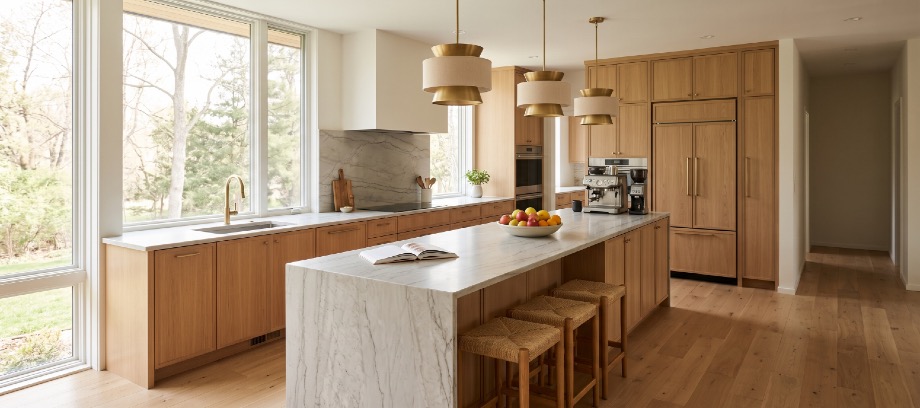
Does the Kitchen Work Triangle Still Matter?
Updated August 2026
If you've read anything about kitchen design, you've run into the work triangle. Sink, refrigerator, cooktop, arranged so you can move between them without crossing the room. For decades that was the rule, and it produced a lot of kitchens that cook well.
The rule isn't wrong. It's just describing a smaller job than the one most kitchens do now.
Think about what happens in yours on a Tuesday. Two people making dinner at once. Somebody's homework spread across the island. Coffee at 6 a.m. while breakfast is happening three feet away. A dog stationed wherever the food is. Add wall ovens, walk-in pantries, beverage fridges, charging drawers, and a room that opens into the living space, and three points on a diagram stop covering it.
So the question worth asking isn't whether your kitchen follows the triangle. It's whether the kitchen works for the way your household actually uses it.
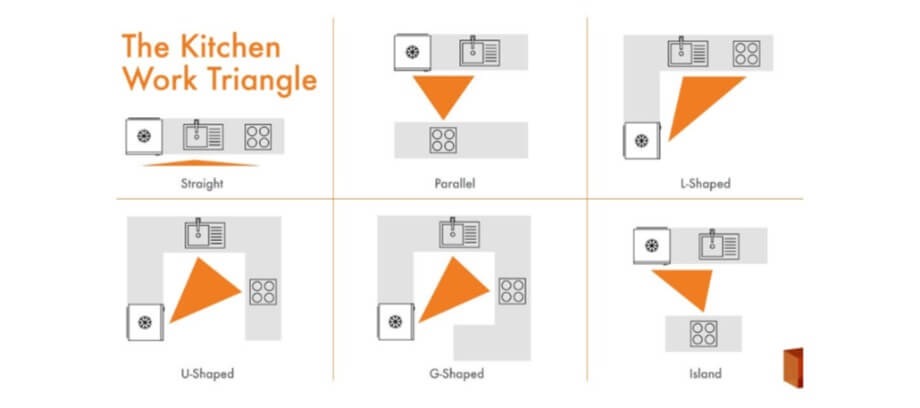
What the triangle gets right
The idea behind the triangle is sound. Three areas do most of the work in a kitchen: the refrigerator where food is stored, the sink where things get washed, and the range where they get cooked. Keep those within a comfortable few steps of each other and cooking feels easy.
You can tell when a layout ignores this. You're carrying dripping produce across the room. There's nowhere to set a hot pan down near the stove. Two people at the sink means one of you is waiting.
In a smaller kitchen with one main cook, the triangle is still a good starting point. It forces a designer to think about how you'll move before deciding where the appliances go, which beats fitting them wherever they happen to land.
It's a starting point, though, not the whole plan.
Modern kitchens need zones
Once a kitchen has a large island, a second sink, a wall oven, or more than one cook, three points can't organize the room. Zones can.
A zoned kitchen groups everything a task requires in the place where you do it. Not every household needs every zone. The ones worth building are the ones that match how you cook.
Prep: knives, boards, mixing bowls, trash and compost pullouts, and open counter next to the sink
Cooking: pots, pans, utensils, oils, and spices within reach of the range
Cleanup: dishwasher, everyday dishes, cleaning supplies, recycling, and a landing spot for what comes off the table
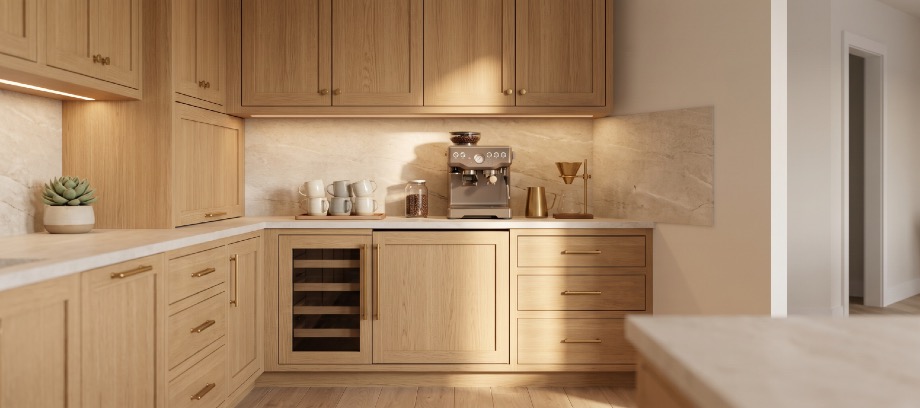
Coffee or beverages: mugs, glasses, the machine, a beverage fridge, and water access, set well outside the cooking path so the morning rush doesn't collide with itself
Baking: the mixer, sheet pans, measuring tools, and a stretch of counter near the oven
Family: charging drawer, school papers, dog leash, and whatever else colonizes the island by Wednesday
If this is the part that resonates, we went deeper on it in the three zones every kitchen needs.
Start with how you actually live
The most useful layouts come out of a conversation, not a formula.
Before anyone picks cabinetry, it helps to answer some plain questions. Do you cook most nights or reheat most nights? Is dinner one person's job or a group project? Do guests always end up leaning against the island no matter where you put the food? Are there kids or pets moving through constantly? Do you buy in bulk, bake often, host in December?
Those answers shape a floor plan more than any design rule.
A family that hosts Sunday dinner needs wide aisles, probably double ovens, and drinks located somewhere that keeps six people out of the cook's way. A serious home cook would rather have deep prep space and storage for the tools they use weekly. Someone remodeling to make daily life easier wants fewer steps between the three main stations and the everyday things at waist height instead of on the top shelf.
The point isn't matching a kitchen you saw online. It's a room that feels obvious to use at 7 a.m. when you haven't had coffee yet.
What your island should make easier
Islands changed how people move through a kitchen. They hold prep space, storage, seating, sometimes a second sink or a cooktop or a microwave drawer, and reliably, the people at your party.
They also cause problems. An island that's too big, asked to do too many jobs, or dropped into the path between the refrigerator and the stove makes the room worse while looking great in photos.
The right island depends on the room and the people in it. Sometimes it's the center of everything. Sometimes it should stay quiet and let the perimeter do the work. In a tight kitchen, a peninsula or a compact work table often serves better than squeezing in an island because islands are expected. If you're weighing options, current island approaches are worth a look, and if an island only fits by removing a wall, that's a cost conversation to have early.
The better question is what the island should make easier, not whether one will fit.
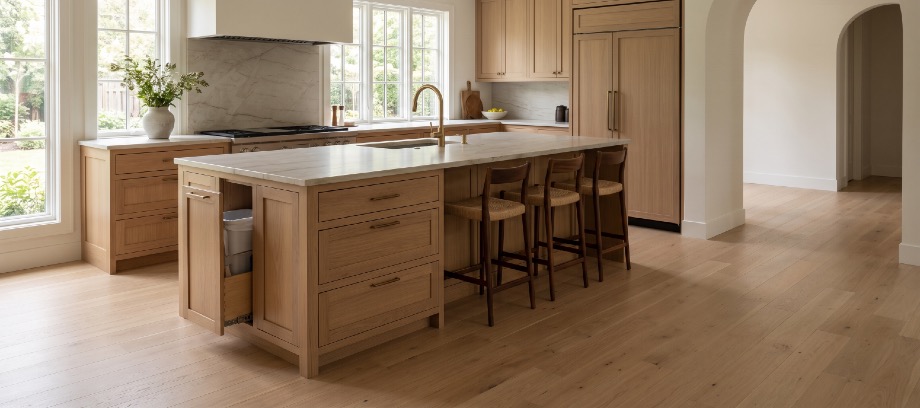
A good layout feels easy
The triangle isn't dead. It's one relationship among several that a designer has to get right.
We still pay attention to the distance between your refrigerator, sink, and cooking surface. That relationship then has to coexist with storage, prep space, appliance placement, how people cut through the room, accessibility now and in fifteen years, and the routines that belong to your house specifically.
Kitchen design at DreamMaker starts with how you want to live in the finished room. The plan takes shape from there: how you cook, who else is in there, what needs to be within reach, and what you want the space to feel like once the crew is gone.
If you're still collecting ideas, our kitchen portfolio shows how these layouts come together in real homes, and this questionnaire helps sort out what matters to you before a first meeting. When you're ready to talk through your own kitchen, let's chat. Good plans start well before the first cabinet goes in.
Let's discuss